What net present value is
Net present value answers a dollar question. Money leaves today. Money comes back later. Those later dollars are not worth the same as dollars in hand. A bird in the hand is worth two in the bush: inflation, and the return you give up by tying the money up, both make a future receipt smaller when you bring it back to today. That restatement is discounting. The rate you discount at is the return you could have earned elsewhere, or, for a bank, the cost of the money it lends.
NPV is the present value of the cash that comes back, minus the cash that goes out. In symbols, with C0 the investment today, Ct the cash flow at time t, r the discount rate, and n the life of the investment:
NPV = −C0 + Σ Ct / (1 + r)t
A sound investment has an NPV well above zero. It creates wealth in today’s dollars, after paying the cost of money. Zero means the project only just earns that cost. A negative figure means it destroys value and should be declined. Between two investments, the higher NPV is the one that adds more wealth. The number is in currency, not in percent, so a large project and a small one can be compared directly.
What the internal rate of return is
The internal rate of return answers a rate question with the same cash flows. It is the discount rate that brings NPV to exactly zero. Think of it as the break-even cost of money. If you can fund the project more cheaply than the IRR, the project adds value. If your money costs more than the IRR, the same project subtracts value. Higher IRR is more attractive, and the bare minimum is an IRR above the cost of capital.
On a simple project, one outlay followed by inflows, the two tests are the same decision stated twice. NPV above zero is the same statement as IRR above the discount rate. They part company when projects differ in size or timing. IRR does not know how many dollars are involved. A small loan and a large loan can share a rate and create very different amounts of value. NPV is the measure that ranks them. IRR is the measure that says how high the cost of money can rise before the project stops being worth doing.
The same ideas, on one loan
The rest of this piece puts those two definitions on a single twelve-month loan. A bank borrows at 5 percent and lends $200,000 at 15 percent. Follow the cash, then the discounting, and the two measures come out as numbers you can check: the customer pays about $216,620, those payments are worth about $210,988 today, NPV is about $10,988, and IRR is 16.1 percent. A $1,000 fee, kept out of that first calculation, lifts the customer’s APR from the 15 percent contract rate to 16 percent.
XYZ Bank’s loan
XYZ Bank borrows from institutional investors and lends the money on to a retail customer. The gap between the rate it pays for money and the rate it charges is the business. The loan we follow has five inputs.
| Input | Value |
|---|---|
| Loan amount | $200,000 |
| Tenure | 12 months |
| Cost of borrowing, the bank’s discount rate | 5% |
| Interest rate charged to the customer | 15% |
| Loan origination fee | $1,000 |
The same loan looks different from each side of the table. The bank has made an investment, so it asks whether the investment clears its cost of money. That is NPV and IRR. The customer has taken a debt, so the customer asks what leaves the bank account each month, and what rate that payment really implies once the fee is counted. That is the equated monthly instalment, and the annual percentage rate.
| Bank, the lender | Customer, the borrower | |
|---|---|---|
| What happens at the start | Pays out $200,000 | Receives the loan |
| What happens each month | Receives a fixed instalment | Pays that instalment |
| The measures that matter | Cash flow, discounted cash flow, NPV, IRR | EMI and APR |
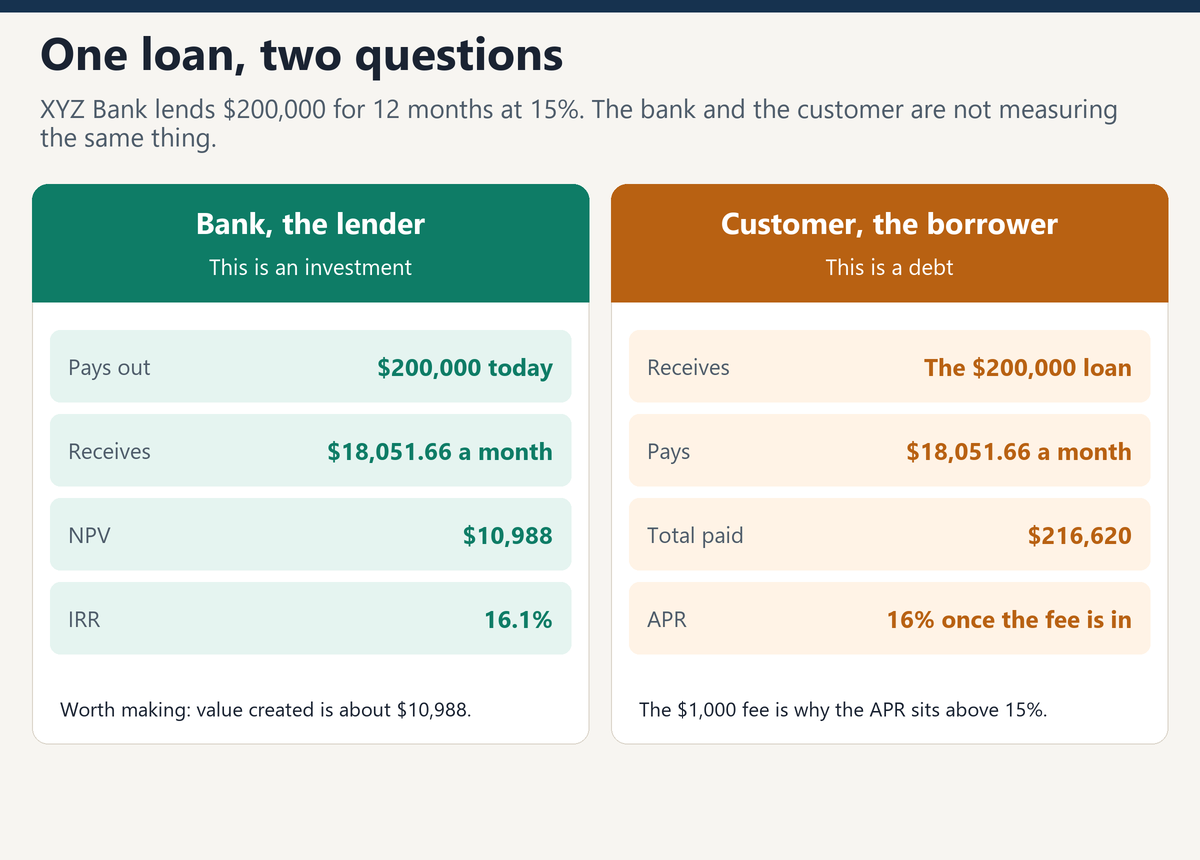
The fee is held back until the APR section. The NPV and IRR below are the loan on its own. The fee is cash the bank receives on day one, so it only improves the bank’s result.
Cash flow comes before any ratio
Cash flow is the record of cash that actually moves. On this loan the bank pays $200,000 on 1 January 2025 and collects twelve instalments, from 1 February 2025 through 1 January 2026. Each instalment is $18,051.66. Twelve of them come to $216,619.95, which rounds to $216,620. Of that, $200,000 repays principal and $16,619.95 is interest.
Excel’s PMT produces the instalment. With the rate entered as a monthly rate, the arguments are the contract rate divided by 12, twelve periods, and the principal of 200,000. The function returns a negative number, because Excel treats it as a payment. From the bank’s side that payment is an inflow, so the cash-flow row uses $18,051.66 as a positive amount and the opening disbursement as a negative one.
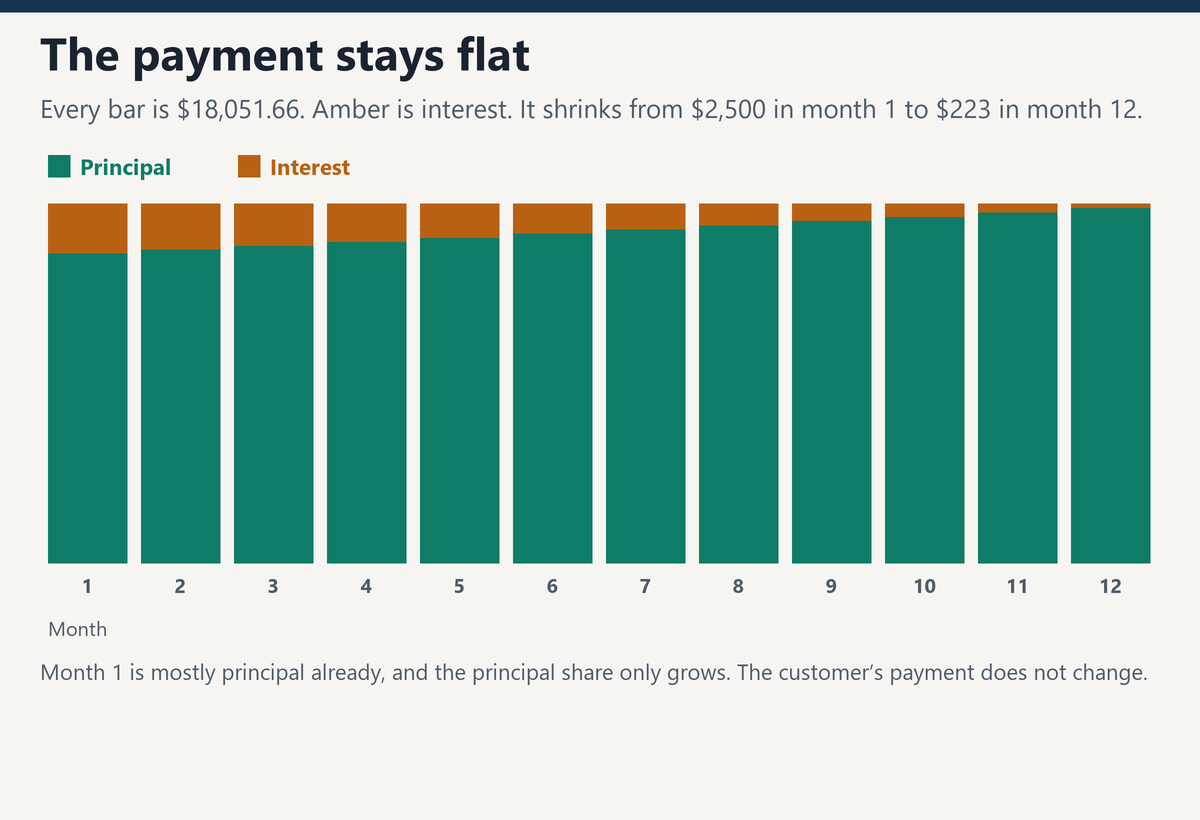
The instalment stays flat. Its mix does not.
An equated monthly instalment is a level payment that covers interest and principal together. Early on, the balance is large, so most of the interest bill sits in the first months. Each payment shrinks the balance, so the interest portion falls and the principal portion rises. The customer’s payment never changes. The bank’s risk does, because principal comes home faster and faster.
Interest in a month is the opening balance times 15% divided by 12. In month one that is $200,000 × 0.0125 = $2,500.00. Principal in that payment is $18,051.66 − $2,500.00 = $15,551.66, and the balance falls to $184,448.34. By month twelve the interest left is $222.86 and almost the entire payment is principal.
| Month | Interest | Principal | Payment | Balance left | Payment, worth today |
|---|---|---|---|---|---|
| 1 Feb 2025 | $2,500.00 | $15,551.66 | $18,051.66 | $184,448.34 | $17,977.01 |
| 1 Mar 2025 | $2,305.60 | $15,746.06 | $18,051.66 | $168,702.28 | $17,907.46 |
| 1 Apr 2025 | $2,108.78 | $15,942.88 | $18,051.66 | $152,759.40 | $17,833.41 |
| 1 May 2025 | $1,909.49 | $16,142.17 | $18,051.66 | $136,617.23 | $17,762.04 |
| 1 Jun 2025 | $1,707.72 | $16,343.95 | $18,051.66 | $120,273.28 | $17,688.59 |
| 1 Jul 2025 | $1,503.42 | $16,548.25 | $18,051.66 | $103,725.03 | $17,617.80 |
| 1 Aug 2025 | $1,296.56 | $16,755.10 | $18,051.66 | $86,969.93 | $17,544.94 |
| 1 Sep 2025 | $1,087.12 | $16,964.54 | $18,051.66 | $70,005.39 | $17,472.39 |
| 1 Oct 2025 | $875.07 | $17,176.60 | $18,051.66 | $52,828.80 | $17,402.46 |
| 1 Nov 2025 | $660.36 | $17,391.30 | $18,051.66 | $35,437.50 | $17,330.50 |
| 1 Dec 2025 | $442.97 | $17,608.69 | $18,051.66 | $17,828.80 | $17,261.14 |
| 1 Jan 2026 | $222.86 | $17,828.80 | $18,051.66 | $0.00 | $17,189.76 |
| Total | $16,619.95 | $200,000.00 | $216,619.95 | $210,987.51 |
Read down the interest column and it steps from $2,500 in the first month to $223 in the last. Read down the principal column and it steps the other way, from $15,552 to $17,829. The payment in every row is the same. The last column is that payment restated in today’s dollars, which is the next idea.
A bird in the hand
Net present value rests on the time value of money. A bird in the hand is worth two in the bush: cash promised later is worth less than cash received now. Inflation is one reason. A sharper reason, for this bank, is that the $200,000 has a cost. Investors charged the bank 5% to supply it. A dollar collected in a year’s time has to be compared with a dollar that could have been used to avoid that cost.
Discounted cash flow is the future cash restated in today’s dollars. On the dated sheet the discount uses the actual number of days and a 365-day year, which is what Excel’s XNPV does. The first instalment arrives 31 days after disbursement:
$18,051.66 ÷ (1.05)31/365 = $17,977.01
Do that for every month and the twelve payments are worth $210,987.51 today, which rounds to $210,988. The gap between $216,620 received over the year and $210,988 in present value is entirely the effect of discounting at 5%. Nothing was lost. The later dollars were translated.
Net present value
Apply the definition from the opening. C0 is the $200,000 disbursed today, each Ct is an instalment, and r is the 5% cost of borrowing. Using the dated discount from the table:
NPV = $210,987.51 − $200,000 = $10,987.51
Rounded, that is $10,988. The loan clears the rule from the opening: NPV is well above zero, so it creates wealth after the cost of money. The next table shows the same loan at higher hurdles. Only the discount rate changes.
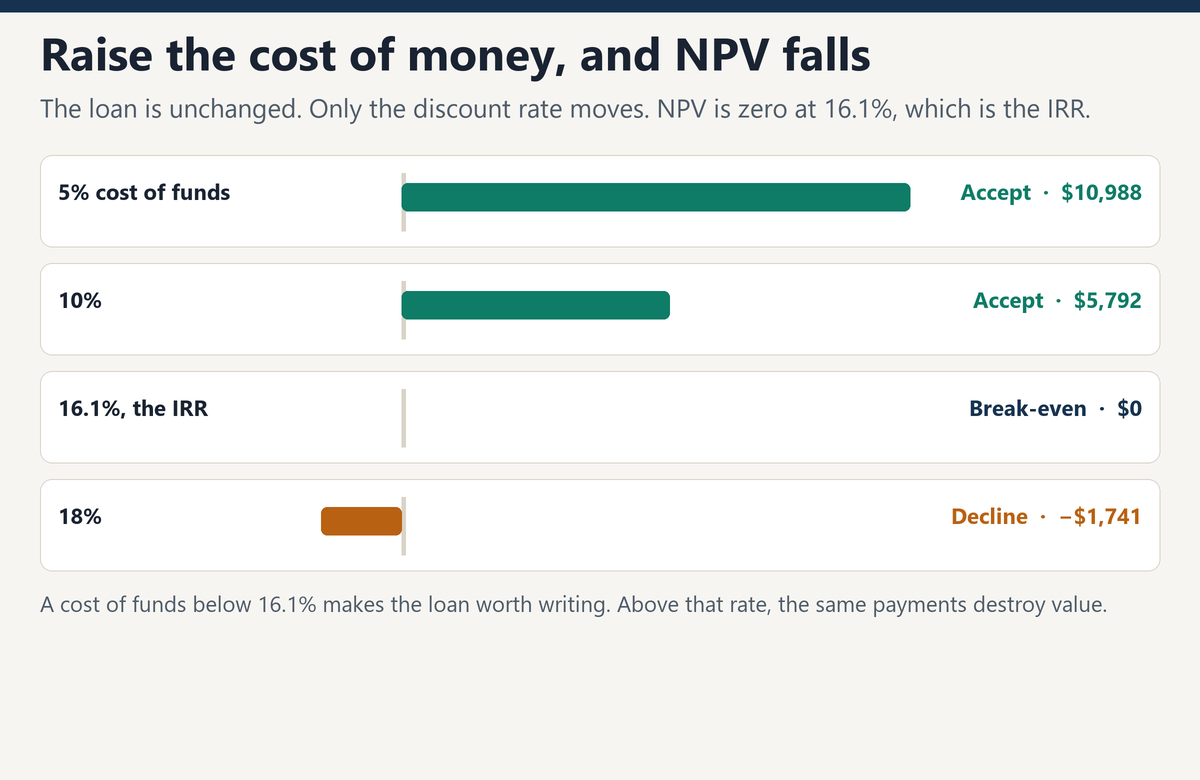
NPV moves as soon as the cost of money moves. The loan is unchanged. Only the hurdle changes.
| Cost of funds used to discount | NPV of this loan | Reading |
|---|---|---|
| 5%, the bank’s actual cost | $10,988 | Creates value. Accept. |
| 10% | $5,792 | Still creates value, about half as much. |
| 16.1%, the IRR | $0 | The loan only just pays its way. |
| 18% | −$1,741 | Destroys value. Decline. |
In Excel, XNPV is the function that matches this sheet, because the cash flows sit on real dates. NPV assumes every period is equal and, in Excel’s convention, that the first cash flow in the range is one period from today. On a monthly grid with a rate of 5% divided by 12, that simpler function gives about $10,865. Same decision, slightly different dollars. The figures in this piece use the dated version.
Internal rate of return
On this loan the definition is visible in the table above. The 16.1% row is the discount rate that sets NPV to zero, so 16.1% is the IRR. At 18%, above that break-even, NPV turns negative and the loan should be declined. At the bank’s actual 5% cost of funds, NPV is $10,988 and the loan should be accepted.
On these dates, XIRR returns 16.07%, which rounds to 16.1%. The cost of funds is 5%. The loan clears that hurdle with room to spare.
Readers often expect the IRR to print as 15%, because 15% is the contract rate. The contract rate is a nominal rate, quoted with monthly compounding. The effective annual rate is (1 + 0.15 / 12)12 − 1 = 16.08%. XIRR reports that effective annual rate, rounded here to 16.1%. The day count runs from 1 January 2025 to 1 January 2026. The 16.1% and the 15% describe one loan. One is the sticker rate. The other is the yearly rate the cash flows actually earn.
APR, the rate the borrower feels
The annual percentage rate folds fees into the rate, so a customer can compare loans that advertise different combinations of rate and charges. The contract rate here is 15%. The origination fee is $1,000. The APR has to come out higher than, or equal to, the contract rate. On this loan it comes out at 16%.
Excel has no single everyday function that takes “rate plus fee” and returns an APR, so the calculation takes two steps.
- Compute the instalment as if the fee were added to the amount being repaid. The principal in
PMTbecomes $201,000. The instalment rises from $18,051.66 to $18,141.92. Twelve of those payments come to $217,703.05. - Ask what rate, charged on the original $200,000, produces that higher instalment. That rate is the APR, 16.0%.
The one-point gap between 15% and 16% is the $1,000 fee, spread across a one-year loan. A longer loan would dilute the same fee into a smaller gap. A larger fee would widen it.
There is a second, equally common version of the same idea: the customer who pays the fee at disbursement only walks away with $199,000, then pays the original instalment of $18,051.66. The rate that equates those cash flows is also 16.0% on this loan. Both routes are saying that a fee makes the loan dearer than the advertised rate.
The formulas on one sheet
Lay the bank’s cash flows in two rows, dates across the top. The first date is 1 January 2025 and the first cash flow is −200,000. The next twelve dates hold 18,051.66 each.
| Measure | Excel | This loan |
|---|---|---|
| EMI | =PMT(15%/12, 12, 200000) |
$18,051.66 a month |
| NPV | =XNPV(5%, cashflows, dates) |
$10,988 |
| IRR | =XIRR(cashflows, dates) |
16.1% |
| EMI with the fee inside the principal | =PMT(15%/12, 12, 201000) |
$18,141.92 |
| APR | =RATE(12, 18141.92, -200000)*12 |
16.0% |
XNPV and XIRR need a consistent sign convention. Money out is negative. Money in is positive. Flipping every sign flips the NPV and leaves the IRR unchanged, which is a useful check that the sheet is pointed at the bank and at the customer in turn.
Update, October 2026: when the two numbers part company
On this loan they do not part company. IRR of 16.1% is above the 5% cost of funds, and NPV is +$10,988. Accept the loan. The interesting cases are the ones where a rate and a dollar figure seem to disagree, and the ones where the inputs move.
Same rate, different amounts of value
Cut the loan from $200,000 to $50,000 and keep every rate the same. The IRR stays 16.1%, because a rate does not know the size of the loan. The NPV falls to about $2,747, because a quarter of the principal creates a quarter of the value. If the bank can fund only one of them, NPV is the measure that picks the $200,000 loan. IRR calls them equal. IRR is the right tool for “does this clear the hurdle?” NPV is the right tool for “which of these creates more wealth?”
What a lower customer rate does
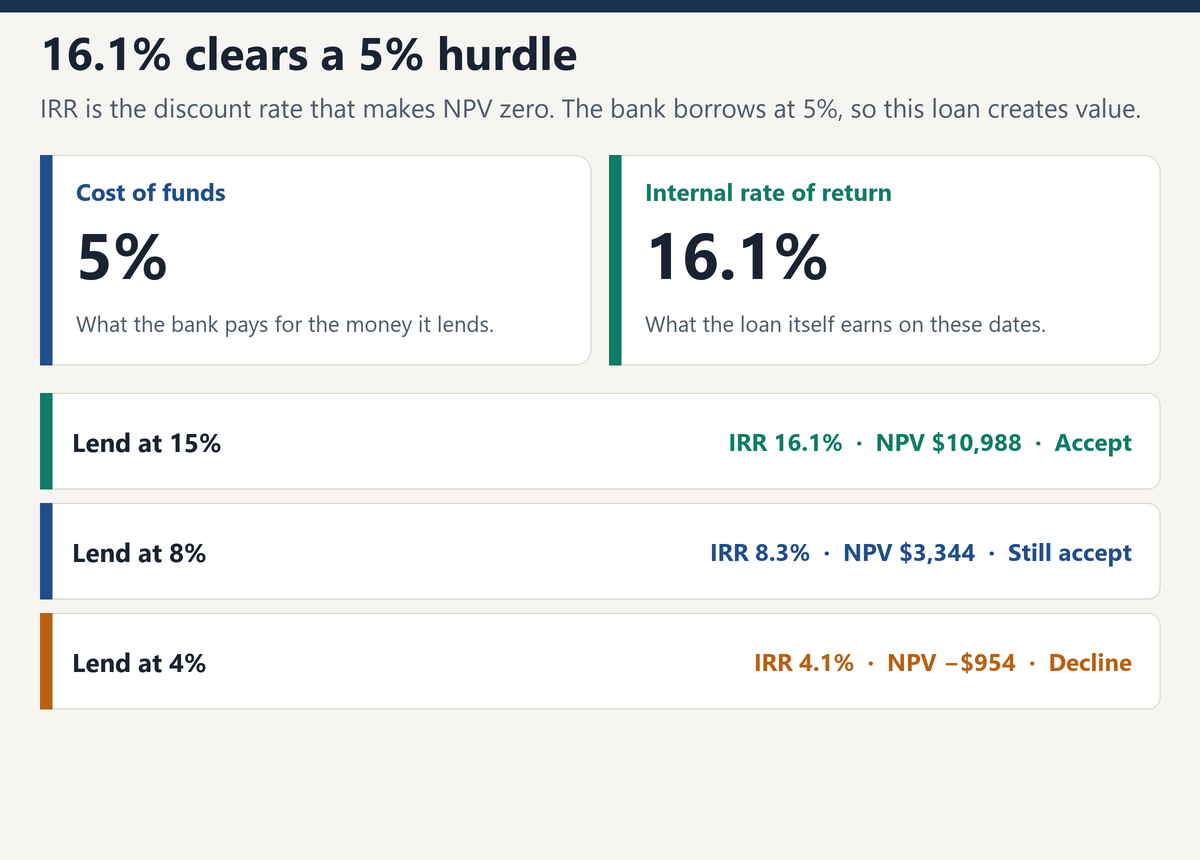
Suppose the desk can only charge 8%. The instalment falls to $17,397.69. NPV falls to about $3,344. The IRR falls to 8.3%. The loan still beats a 5% cost of funds, and it creates about a third of the value the 15% loan created. Drop the customer rate to 4% and the NPV turns to about −$954. The IRR falls to 4.1%, below the cost of funds. That loan should not be written.
Lending at a contract rate of exactly 5% still leaves a small positive NPV, about $116, because monthly compounding makes the effective return 5.1%, a little above the 5% annual discount rate. The sign change arrives once the contract rate is down near 4%.
Where the $1,000 fee belongs
The published NPV of $10,988 ignores the origination fee. Collected on day one, the fee is already present value, so it adds about $1,000. NPV including the fee is about $11,988, and the IRR rises further above 16.1%. For the customer, that same fee is why the APR is 16% and the contract rate is 15%. A comparison of loans that leaves fees out of the cash flows will flatter the lender’s IRR and understate the borrower’s cost.
The reinvestment story packed inside IRR
IRR quietly assumes each instalment can be put back to work at the IRR itself, here 16.1%. A bank that funded this loan at 5% will not, in general, find another 16.1% home for every monthly receipt. NPV assumes the receipts earn the discount rate, the 5% cost of funds. That is the more honest picture of what the bank gives up. It is the reason a high IRR on a small, short loan can lose a ranking contest to a lower IRR on a large loan with a long stream of cash. Modified IRR exists to force a chosen reinvestment rate. For a yes-or-no decision on a single conventional loan, NPV already does the job.
The same arithmetic outside a bank
For a personal investment the “cost of funds” is the return you give up. A fixed deposit, a bond ladder, or a broad fund can play the role that 5% plays for XYZ Bank. Discount the rent, coupons, or dividends at that rate, subtract what you pay today, and read the NPV. The IRR is the yield the investment has to be compared with that alternative. A positive NPV and an IRR above the alternative are one decision, stated twice, for a simple outlay followed by inflows. When two investments are different sizes, let NPV rank them.
Five checks before you say yes
- Write every cash movement, including fees, with its date. Ratios computed from a slogan rate skip this step and go wrong.
- Name the discount rate as a real alternative: the bank’s cost of borrowing, or the return an investor gives up.
- Accept when NPV is clearly above zero. A figure sitting on zero only recovers the cost of money.
- Read IRR as the hurdle the project can withstand. It has to exceed the discount rate. On a conventional project, that is the same test as a positive NPV.
- If you are the borrower, look at the APR beside the contract rate. The gap is the fee, translated into a rate.
On XYZ Bank’s $200,000 loan those checks land in one place. The customer pays $18,051.66 a month and $216,620 over the year. Discounted at the bank’s 5% cost of money, the payments are worth $210,988 today. The bank is better off by $10,988 in present value. The loan earns 16.1% against a 5% hurdle. With the $1,000 fee counted, the customer’s APR is 16%. The loan is worth making. A loan that failed any one of those tests would not be.
Rounded headlines are $216,620, $210,988, $10,988, 16.1%, and 16%. Unrounded Excel values are $216,619.95, $210,987.51, $10,987.51, and 16.07%. This is an explanation of the method, not a credit offer or an investment recommendation.

