What is BFSI?
- BFSI is an acronym for Banking, Financial Services and Insurance. This covers a whole gamut of activities and business models.
- Wiki defines – “ BFSI comprises commercial banks, insurance companies, non-banking financial companies, cooperatives, pensions funds, mutual funds and other smaller financial entities. Banking may include core banking, retail, private, corporate, investment, cards and the like ”
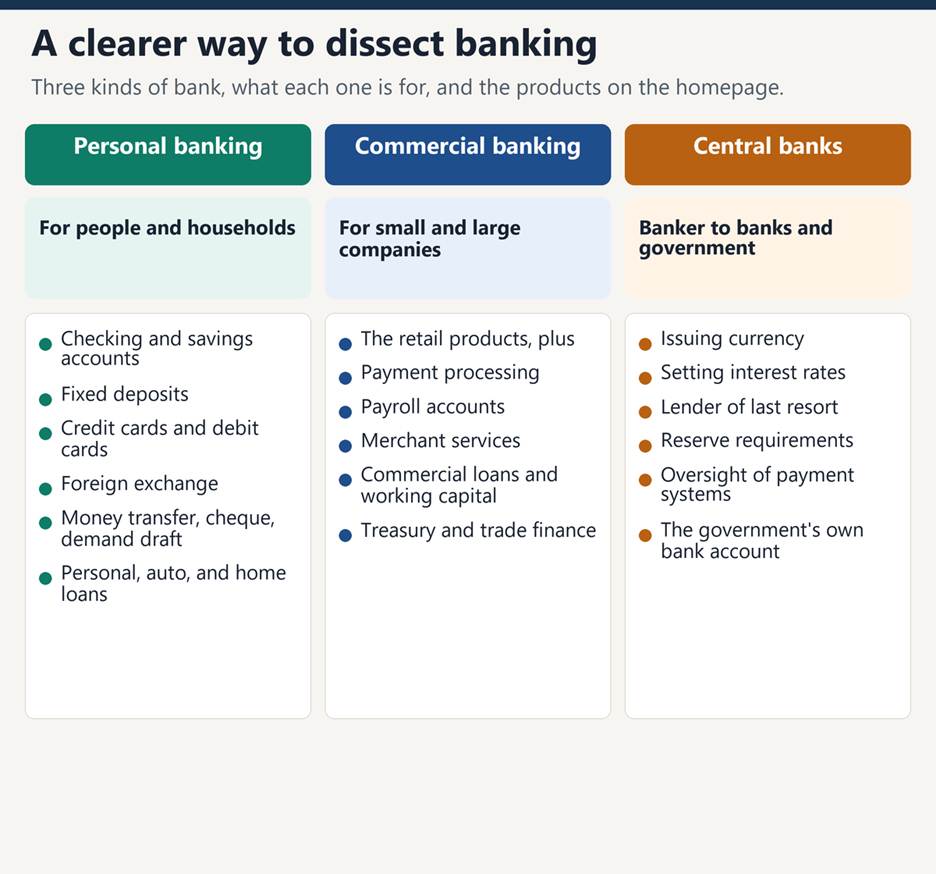
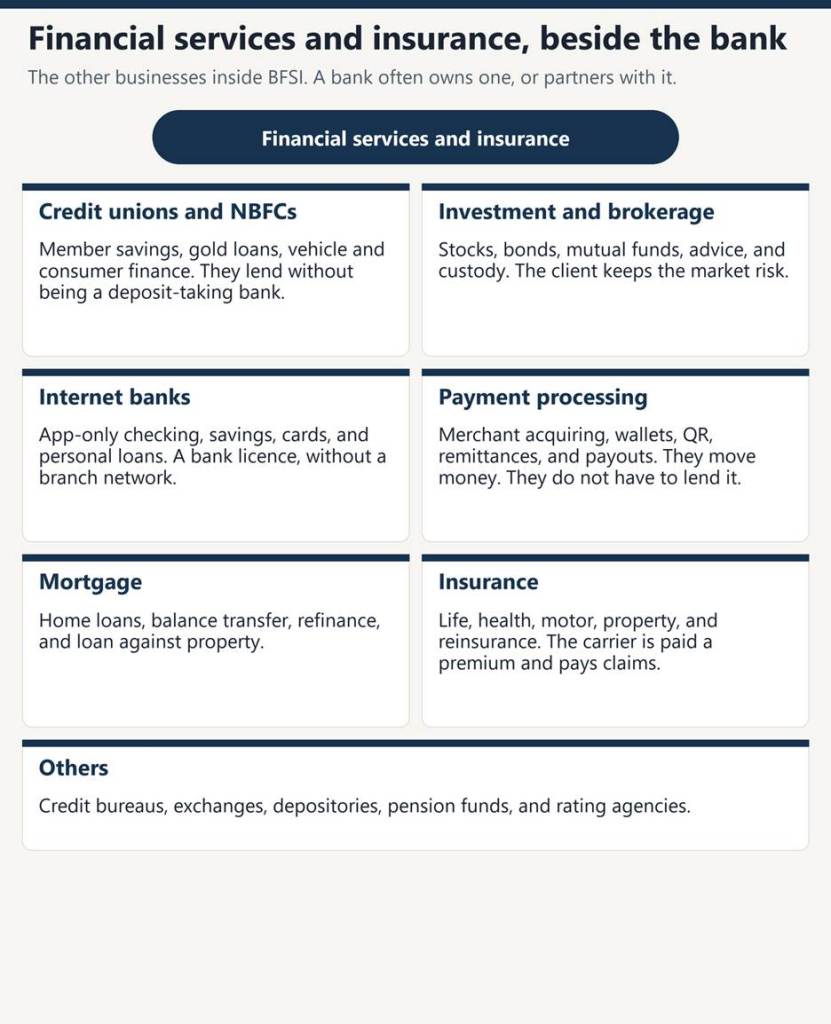
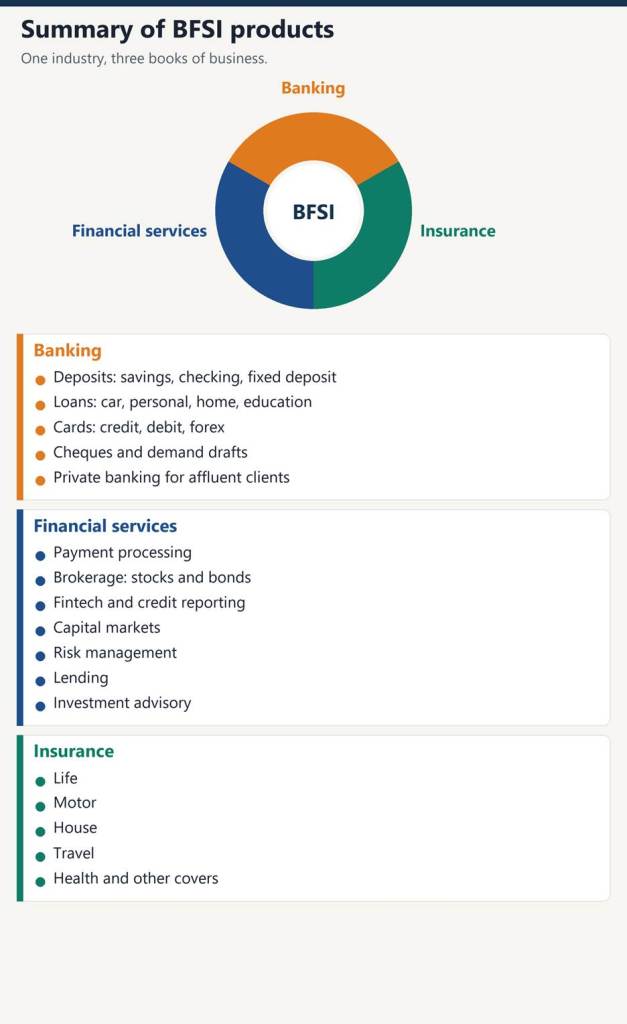
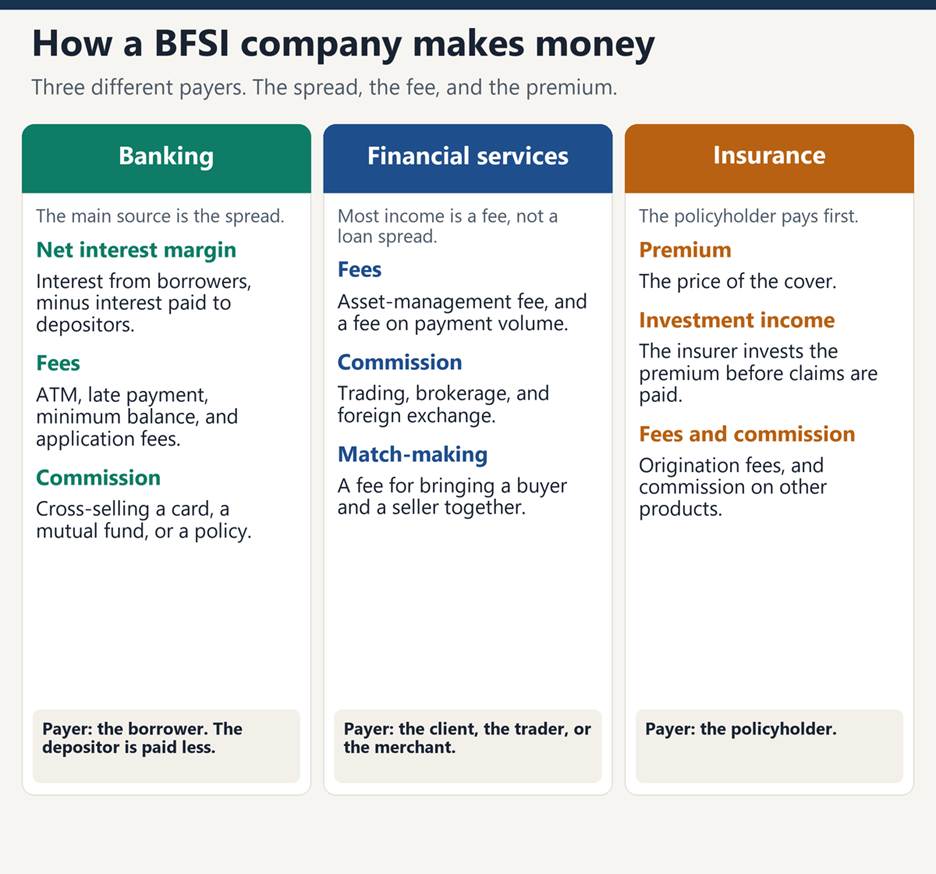
Activity- Explore the below pages. List down different products and services that you see?
- https://www.chase.com/
- https://www.creditkarma.com/
- http://www.boc.cn/en/
- https://www.hsbc.co.in/1/2/homepage#
- https://www.wellsfargo.com/
- https://paytm.com/
- https://www.icicibank.com/
- https://www.hdfcbank.com/
- https://www.banamex.com/en/
- https://www.onlinesbi.com/
The definition above is still the right starting point. The useful next step is to sort every product by who holds the risk and who gets paid. A non-banking financial company lends without taking deposits. A payments firm moves money without lending it. A marketplace sells someone else’s loan or policy and keeps a commission. That last distinction is most of what people now call fintech.
Four pillars inside BFSI
| Pillar | What it sells | Who keeps the risk | Who pays |
| Retail and SME banking | Deposits, payments, cards, personal and home loans, current accounts | The bank’s own balance sheet | Borrowers pay interest. Card spend generates interchange. Some accounts pay a fee. |
| Wholesale and markets | Trade finance, cash management, equity and debt capital markets, M&A advisory, custody | The bank’s balance sheet, or the client’s, depending on the product | Companies and funds pay interest, advisory fees, and a fee in basis points of assets. |
| Asset management and pensions | Mutual funds, ETFs, retirement products, wealth advice | The investor. The manager does not promise the return. | The client pays a fee in basis points of assets. Some funds also charge a performance fee. |
| Insurance | Life, health, motor, property, and reinsurance | The carrier, then the reinsurer for the slice that is passed on | The policyholder pays premium. The carrier invests the float before claims are paid. |
Banking inside the original definition already splits into core banking, retail, private, corporate, investment, and cards. Core banking is the system of record. The others are products that sit on top of it.
If you opened the ten sites, these are the products you should be able to name, and the way each institution is paid. Several names are groups, so the homepage is only the front door.
| Site | Products and services | How that institution is paid |
| Chase | Checking and savings, credit cards, mortgage, auto loans, investing, business banking, merchant services | Net interest on loans funded by deposits, card fees and interchange, treasury and wealth fees |
| Credit Karma | Free credit scores, card and loan offers, insurance quotes, tax filing through Intuit | Lenders and insurers pay per approved customer. The score is the free hook. |
| Bank of China | Retail deposits and loans, corporate banking, trade finance, FX and RMB cross-border services, investment banking | A universal bank: interest margin, plus fees on trade, FX, and advisory |
| HSBC India | Savings, NRI accounts, cards, home loans, wealth, corporate banking and trade | The same universal-bank mix, with a large non-resident and cross-border book |
| Wells Fargo | Consumer banking, mortgage, auto, cards, advice-led wealth, commercial banking | Net interest is the engine. Advice and treasury fees are the second line. |
| Paytm | UPI and QR, merchant devices, bill payments, gold, insurance, personal and merchant loans | Merchant devices and payment fees, plus commissions on credit and insurance |
| ICICI Bank | Deposits, cards, retail loans, iMobile, wealth, corporate banking, group insurance | Net interest, card income, and fees from distributing insurance and investments |
| HDFC Bank | Retail deposits and loans, cards, wholesale banking, payments. The old HDFC Ltd mortgage book now sits inside the bank. | Net interest after the 2023 merger, plus fees and cards |
| Banamex | Mexico retail banking, cards, mortgages, and the local consumer franchise that sat inside Citi | A full-service retail and corporate bank |
| SBI | Deposits, loans, YONO, government business, cards through SBI Card, life and general insurance joint ventures, mutual funds | Net interest on a very large deposit base, plus fees and income from associate companies |
New-age startups in BFSI and fintech
The firms below were mostly founded after 2008. They pulled one product out of a universal bank, shipped it as an app or an API, and charged for a thinner slice. By 2025 the cohort that started this around 2010–2018 was large enough to matter on its own. Venture funding into fintech fell 41% that year, to $26.1 billion, while revenue at the 50 largest profitable fintechs rose 29%, to $187 billion.
Four rails made that possible: India’s UPI and account aggregator, Brazil’s Pix, Europe’s open-banking rules, and US card economics that still pay the card issuer a share of each swipe. A startup can sit on those rails without owning a branch network.
Chase, SBI, HDFC, and ICICI earn a net interest margin because they hold loans against deposits. Chime, Plaid, Policybazaar, and a pure payments gateway do not. Nubank, SoFi, Monzo, and Revolut started as a slice of the bank and later took a licence so they could keep the margin. That licence, more than the app, is what turns a fintech into a bank.
Nine revenue models
Every firm in the directory uses one of these as its main engine. Most add a second engine once they have customers. The question to ask of any pitch is: who pays, on what event, and who eats the loss if the customer does not repay.
| Model | Who pays | What triggers the charge | Firms |
| Payments take-rate | The merchant or the business | A percent of volume successfully collected or paid out, sometimes plus a fixed fee | Stripe, Adyen, Razorpay, PhonePe, Paytm, dLocal, Flutterwave, Wave, Toss |
| Card interchange | The merchant’s bank, through the card networks | Each swipe or tap. The issuer’s share is the neobank’s revenue. | Revolut (largest slice), Chime, Monzo, Ramp |
| FX and spread | The person or company converting currency | A fee and a thin markup on the mid-market rate, or interest on balances parked between transfers | Wise, Airwallex. Revolut also has an FX line. |
| Net interest | The borrower | Interest received on loans and cards, minus interest paid on deposits | Nubank, SoFi, WeBank, Tyme. Interest was 21.6% of Revolut’s 2025 income. |
| BNPL fee | The merchant, then the shopper if they finance for longer | A merchant discount higher than a normal card rate, plus interest on instalment loans | Klarna, Affirm |
| Brokerage | The trader, the market maker, or both | A flat or zero commission, payment for order flow, margin interest, or a spread on crypto | Zerodha, Groww, Robinhood |
| Software and API | The bank or the fintech, not the end consumer | A subscription, a per-connection fee, or a platform fee per card | Plaid, Marqeta, Mambu |
| Distribution | The lender or insurer whose product is sold | A commission when a loan or policy is completed. The app does not keep the credit or insurance risk. | Policybazaar. Also a second engine at PhonePe, Paytm, and Credit Karma. |
| Insurance premium | The policyholder | Premium comes in. Claims and reinsurance go out. The carrier keeps a fee or an underwriting margin. | Lemonade. Policybazaar never takes the claim. |
Revolut’s 2025 income mix
Revolut is the cleanest public illustration of a super-app bank. Fee lines were 76% of turnover, so the group is less tied to interest rates than a traditional bank. No single line was more than a quarter of income. Business accounts were 16% of income. Revenue was £4.5 billion, up 46%. Profit before tax was £1.7 billion. Net profit was £1.3 billion. Retail customers reached 68.3 million. A secondary sale implied a $75 billion valuation.
| Income line | Share of 2025 group income |
| Card payments | 22.2% |
| Interest income | 21.6% |
| Subscriptions | 15.7% |
| Wealth | 14.7% |
| FX | 13.4% |
| Other | 12.4% |
Source: Revolut Group Holdings Ltd annual report for the year ended 31 December 2025. “Other” is the residual after the five named lines.
Latest revenue, selected firms
These numbers are approximate and they do not share one fiscal year. They are here so the revenue models above have a sense of scale.
| Firm | Approximate annual revenue | What the figure is |
| Stripe | $20 billion | 2025 private-company estimate, not a filing |
| Nubank | $10 billion | 2025. Published roundups range from about $9.4 billion to $10.6 billion. |
| Revolut | £4.5 billion (about $5.7 billion) | Reported 2025 revenue. Dollars use about 1.27 USD per GBP. |
| WeBank | $5.4 billion | Third-party 2025 comps for the Tencent-linked digital bank |
| Klarna | $3.5 billion | 2025 figure cited in public comps |
| Wise | $2.5 billion | Reported FY2026 net revenue, year ended 31 March 2026, up 19% |
| Adyen | $2.2 billion | 2025 net revenue, as cited in results roundups |
| Zerodha | ₹8,847 crore (about $1.1 billion) | FY25 revenue, roughly flat into FY26. Profit after tax about ₹4,200 crore. Rupees converted at ₹84 per USD. |
| PhonePe | ₹7,115 crore (about $0.85 billion) | FY25 revenue from operations, from its DRHP |
| Razorpay | ₹3,783 crore (about $0.45 billion) | FY25 operating revenue. A confidential IPO filing was reported in 2026. |
PayPal and Block are larger, and they are older than this cohort. Block’s gross revenue is swollen by bitcoin that passes through the Cash App, so it is a poor comparison with the net revenue figures above. Wise is worth a separate line: FY2026 cross-border volume was $244 billion, the cross-border take rate was 0.52% (down from 0.58% the year before), and almost half of net revenue came from card spend and interest on balances rather than from the transfer itself.
Worldwide directory: who they are and how they charge
Primary model means the main engine. Most of these firms have a second one.
| Firm | Base | Founded | Segment | Primary model | How the money is made | Scale |
| Stripe | United States | 2010 | Payments infrastructure | Payments take-rate | The merchant pays, not the shopper. Online cards are often priced near 2.9% + $0.30 in the US, with volume discounts for large sellers. Billing is a software subscription. Issuing shares card interchange. Capital is a merchant advance repaid as a percent of future sales. | About $20 billion revenue in 2025, a private-company estimate |
| Adyen | Netherlands | 2006 | Enterprise payments | Payments take-rate | Interchange++ pricing. The merchant pays scheme fees and interchange at cost, plus Adyen’s processing fee and a small fixed fee. Revenue scales with volume. | About $2.2 billion net revenue in 2025 |
| dLocal | Uruguay | 2016 | Emerging-market payments | Payments take-rate | Global merchants pay a take-rate to collect from, or pay out to, customers on local rails such as Pix, boleto, local cards, and wallets. | Listed. Revenue is a take-rate on pay-in and pay-out volume. |
| Razorpay | India | 2014 | Merchant payments | Payments take-rate | Businesses pay a merchant discount on cards, payment links, and subscriptions. UPI itself is a thin or zero fee, so Razorpay also earns on payouts, current accounts, and a share of SME credit. | FY25 operating revenue ₹3,783 crore |
| PhonePe | India | 2015 | Payments super-app | Payments take-rate | Person-to-person UPI is free. Money comes from merchants (QR, devices, gateway), convenience fees on some bills, and commissions on loans and insurance. Newer bets include broking (Share.Market) and an app store. | FY25 revenue from operations ₹7,115 crore |
| Paytm | India | 2010 | Payments and devices | Payments take-rate | Merchants pay for soundboxes, QR, and payment processing. A second engine is distribution of personal loans, merchant loans, and insurance, with credit risk mostly on partner NBFCs and banks. | Listed in India |
| Flutterwave | Nigeria | 2016 | Africa payments infrastructure | Payments take-rate | Businesses pay a percent of volume, sometimes plus a fixed fee, to accept payments and pay out across African markets through one API. | Private |
| Wave | Senegal | 2018 | Mobile money | Payments take-rate | Customers pay about a 1% fee to send money. There is no monthly account fee. Agents are the distribution network. | Private. Scale is West African transfer volume. |
| Toss | South Korea | 2015 | Super-app | Payments take-rate | Started as a free transfer app. Income now stacks payments, Toss Securities brokerage, advertising, and lending. | Private Korean super-app |
| Wise | United Kingdom | 2011 | Cross-border account | FX and spread | Customers pay an explicit fee. Wise shows the mid-market rate and takes a small cut of volume. Card spend and interest on balances are now almost half of net revenue. | FY2026 net revenue $2.5 billion. Cross-border take rate 0.52%. |
| Airwallex | Singapore / Australia | 2015 | Business treasury | FX and spread | Companies hold many currencies and pay a markup on conversion plus fees on collections and payouts. | Private. Sold to businesses rather than consumers. |
| Revolut | United Kingdom | 2015 | Digital bank | Card interchange | Card payments, interest, paid plans, wealth, and FX. See the income mix above. The largest single line in 2025 was card payments, at 22.2%. | 2025 revenue £4.5 billion. Profit before tax £1.7 billion. |
| Chime | United States | 2012 | Neobank | Card interchange | No monthly fee. Chime earns debit interchange when customers spend, which is why direct deposit sits at the centre of the product. Deposits are held at partner banks. | Private |
| Monzo | United Kingdom | 2015 | Neobank | Card interchange | Current-account interchange, paid Plus and Premium plans, and a growing loan book. It holds a UK banking licence, so deposits can fund lending. | Private UK bank |
| Ramp | United States | 2019 | Corporate cards | Card interchange | Employer card spend generates commercial interchange. Ramp returns part of that as cash back, keeps the rest, and charges for spend-management software. Brex is the same family. | Private |
| Nubank | Brazil | 2013 | Digital bank | Net interest | The card is the wedge. The profit pool is interest and fees on cards and loans, funded by a large low-cost deposit base. Mexico and Colombia are the expansion markets. | About $10 billion revenue in 2025. Well above 100 million customers. |
| SoFi | United States | 2011 | Digital bank | Net interest | A national bank charter lets SoFi fund personal loans, student-loan refinance, and mortgages with its own deposits. Fees also come from investing, cards, and the Galileo platform sold to other fintechs. | Listed US bank |
| WeBank | China | 2014 | Digital bank | Net interest | Small consumer and small-business loans distributed inside WeChat, funded by deposits. Interest margin is the engine. There is no branch network. | About $5.4 billion revenue in third-party 2025 comps |
| Tyme | South Africa | 2015 | Digital bank | Net interest | TymeBank in South Africa and GoTyme in the Philippines use retail partners and kiosks instead of branches. Income mixes card interchange with interest on credit. | Private |
| Klarna | Sweden | 2005 | BNPL and neobank | BNPL fee | The merchant pays a fee well above a normal card rate because instalments lift checkout conversion. Consumers pay interest on longer financing, and late fees in some countries. Klarna has added a debit card and deposit accounts. | About $3.5 billion revenue cited for 2025 |
| Affirm | United States | 2012 | BNPL | BNPL fee | Merchants pay a discount rate to offer pay-over-time at checkout. Longer loans also earn interest from the consumer. Affirm does not charge late fees, so the merchant discount plus interest has to cover credit losses. | Listed |
| Zerodha | India | 2010 | Broker | Brokerage | Equity delivery is ₹0. Intraday and F&O are a flat ₹20 per order. The second engine is interest on margin funding. Zerodha Fund House adds a small asset-management fee. There is no payment for order flow. | Revenue about ₹8,847 crore. Profit after tax about ₹4,200 crore. Bootstrapped. |
| Groww | India | 2016 | Investing app | Brokerage | Brokerage and derivatives are still most of the income, plus interest on margin trading. Mutual-fund distribution and Groww’s own asset manager add a fee on assets. | Listed. Active clients exceed Zerodha’s. Revenue and profit do not, yet. |
| Robinhood | United States | 2013 | Broker | Brokerage | Commission is $0 to the customer. Market makers pay for order flow. Robinhood also earns net interest on customer cash and margin, a Gold subscription, and a spread on crypto. | Listed. Zero commission can still be a large business if someone else pays. |
| Plaid | United States | 2013 | Open banking | Software and API | The fintech app pays, per connection or per use, to verify accounts, pull balances, and move money. The person who owns the bank account does not pay Plaid. | About $500 million annualized revenue cited for 2025 |
| Marqeta | United States | 2010 | Card issuing | Software and API | Fintechs and brands pay a platform fee and share interchange on cards Marqeta issues for them. Marqeta is the factory. The neobank is the brand. | About $780 million revenue cited for 2025. Listed. |
| Mambu | Netherlands | 2011 | Core banking SaaS | Software and API | Banks and lenders pay a subscription, priced on accounts or usage, to run deposits and loans on a cloud core. The client keeps the balance sheet. | Private. Contracted software revenue. |
| Policybazaar | India | 2008 | Insurance marketplace | Distribution | The insurer pays a commission when a policy is sold, plus a trail on renewals. Comparing policies is free for the customer. Listed as PB Fintech. | A distribution business, not an insurance carrier |
| Lemonade | United States | 2015 | Insurtech carrier | Insurance premium | The customer pays a premium. Lemonade keeps a fixed fee and uses the rest for claims and reinsurance. It keeps insurance risk. Renters, home, pet, car, and life. | Listed. Profitability depends on the loss ratio. |
How to read the next fintech you see
Name the rail it sits on: cards, UPI, Pix, SWIFT, a broker exchange, or an insurance licence. Name the payer: merchant, borrower, policyholder, or another financial firm. Then ask whether losses stay with the startup. If they do, it is a balance-sheet business, and capital and bad debts matter more than app downloads. If they do not, it is a take-rate, software, or commission business, and the risk sits at a bank, NBFC, or insurer whose brand you may never see on the homepage.
Figures mix fiscal years, currencies, and gross versus net revenue. Stripe’s $20 billion is an outside estimate. India’s numbers are rupee operating revenue. This is a study map for the original BFSI note, not a ranking for investment.
Sources used for the update: Revolut Group Holdings Ltd, Annual Report 2025; Wise Group plc, FY2026 results; PhonePe’s DRHP and Indian press on Razorpay FY25 and Zerodha FY25/FY26; 2025 fintech revenue roundups, including CB Insights figures reported by TechBullion.
Thank you!

