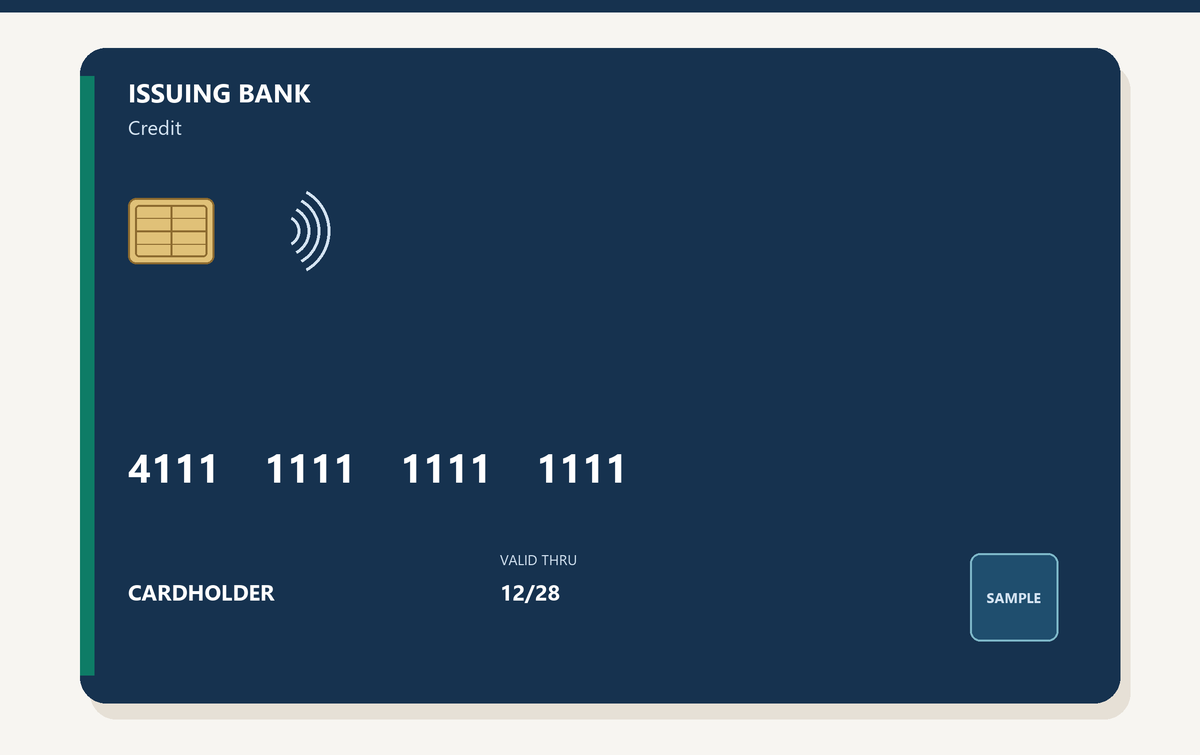
What a credit card is
A credit card is a payment card an issuer, usually a bank, gives you so you can pay a merchant now and repay the issuer later. The issuer opens a revolving account and grants a line of credit, up to a credit limit. From that line you can pay a merchant or, on many cards, take a cash advance. You promise to repay what the issuer paid on your behalf, plus the interest and fees in the agreement.
The account revolves. Pay what you owe and the line is available again. Pay less than the full statement and the unpaid part remains as a balance you can keep drawing on. Interest is charged on a balance that remains. A charge card is the near relative that does not revolve: that balance has to be repaid in full each month. A debit card or a cash card spends money already in your account and can be used like cash. A credit card spends the issuer’s money first. You reimburse the issuer. The merchant is paid by the issuer’s side of the arrangement, not by you handing over the cash at the till.
For a few weeks that loan can cost nothing, which is the grace period on ordinary purchases when the statement is paid in full. Leave a balance, and the same card is an interest-bearing loan. One piece of plastic is a way to pay for the cardholder and a lending business for the bank.
The number on the card
The digits are how the networks tell one account from another. The opening digits identify the network and the issuer. The middle digits are the account. The last digit is a check digit, so a mistyped number fails before anyone asks the issuer for credit. The deck lists the opening digit and the length this way.
| Network | Starting digit, as the deck lists it | Length, up to |
|---|---|---|
| Mastercard | 2 or 5 | 16 |
| Maestro | 2 or 5 | 19 |
| Visa | 4 | 19 |
| Diners | 3 | 14 |
| Discover | 6 | 16 |
| American Express | 3 | 15 |
“Up to” is the deck’s wording. A Visa card you hold is often 16 digits even though the numbering plan allows a longer one. Mastercard’s 2-series sits beside the familiar 5-series. American Express and Diners can both start with 3 and are told apart by the following digits and by the length.
How a credit card works
The definition stops at the promise. Using the card is a separate sequence: a shop asks whether the credit is there, and only later does money move and a bill arrive. On a typical Visa or Mastercard purchase, five parties handle that sequence. American Express often plays more than one of the roles itself. The steps are the same idea either way.
Five parties stand behind one swipe
| Party | Who it is | What it does on this purchase |
|---|---|---|
| Cardholder | You | Asks for the goods and later receives the bill |
| Merchant | The shop | Sends the charge and, at the end of the day, the batch of approved sales |
| Acquirer | The merchant’s bank | Accepts the request, and later pays the merchant after its own fee |
| Card network | Visa, Mastercard, or another scheme | Carries the message between acquirer and issuer, and shares in the interchange |
| Issuer | The bank that gave you the card | Approves or declines, and later funds the sale by taking on your debt |
The work happens in four steps. Authorization is a question: is there credit available? Batching collects the day’s yeses. Clearing asks the issuer to pay. Funding is when the merchant finally receives money and you are billed. The goods can leave the shop at step one. The bank’s money moves at steps three and four.
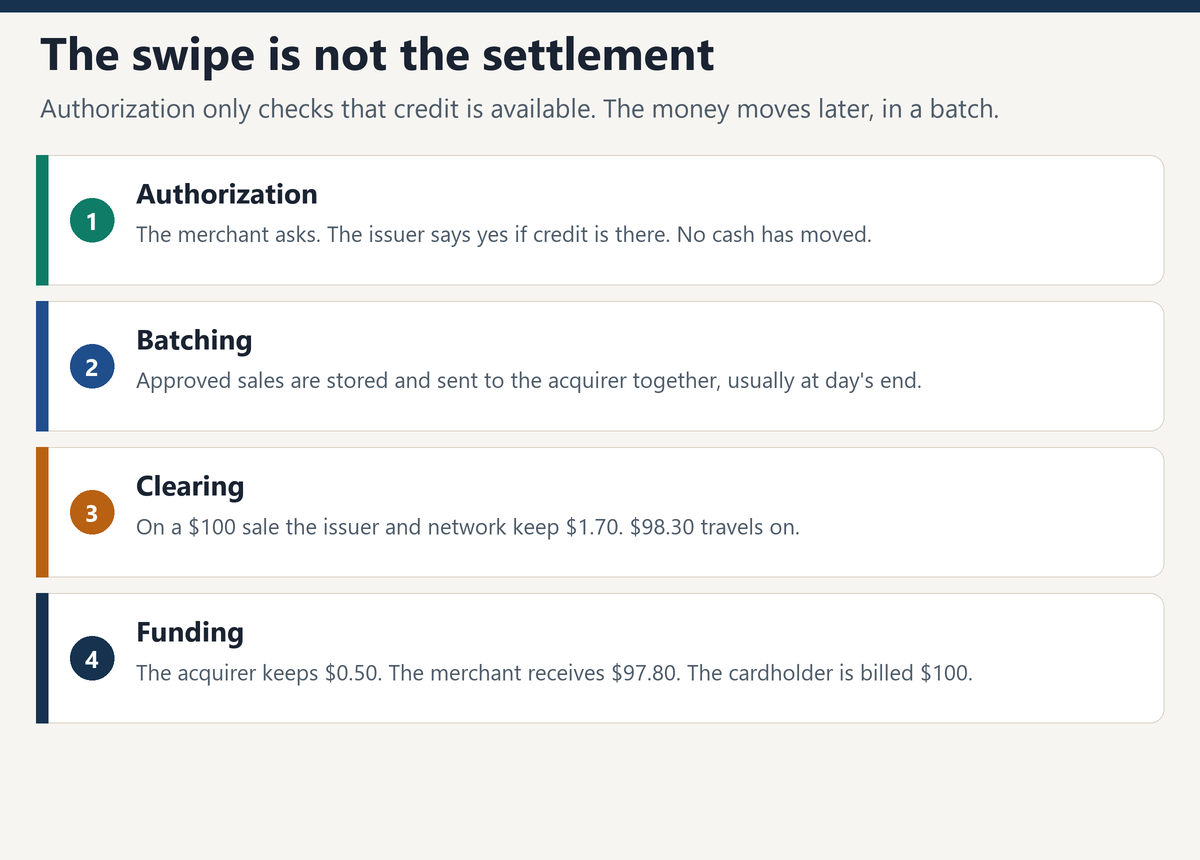
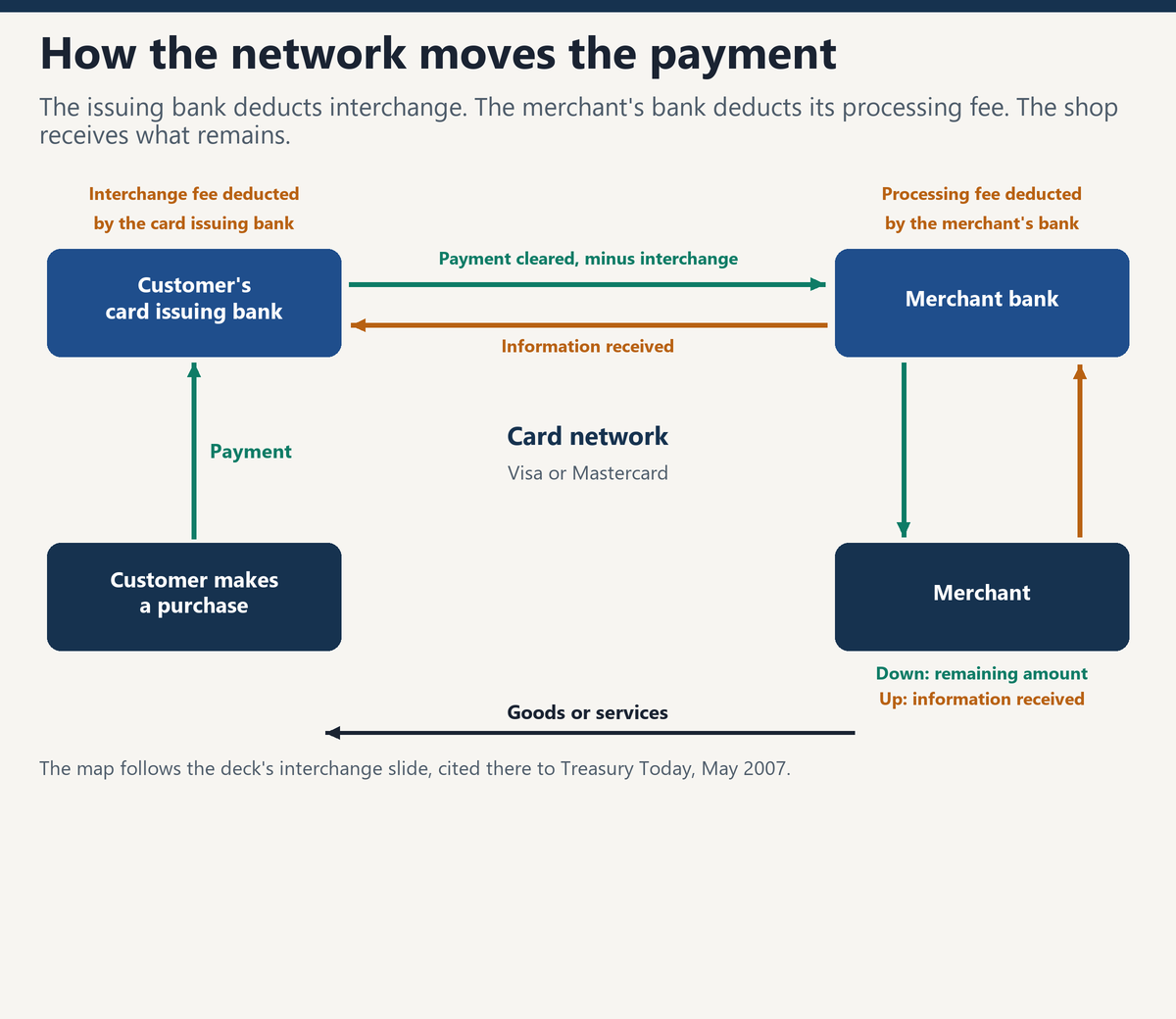
Drawn as the deck’s interchange map, the same parties show who keeps which fee. The customer pays the issuing bank. That bank deducts interchange and clears the rest to the merchant’s bank. The merchant’s bank deducts its own processing fee and pays the shop what remains. The shop sends the goods the other way. Information travels back along the same links, through Visa or Mastercard.
Follow one $100 sale
The figures in this section are the worked example in the CreditCards.com note How a credit card is processed. They are one ticket from that 2013 walk-through, not a current rate card. Interchange on real cards is a schedule, and it moves with the network, the type of card, and the kind of merchant. The glossary in that note puts the usual range at about 1 to 3 percent. The plumbing is what has stayed put.
Authorization
You ask the merchant for a $100 purchase. The merchant sends the card details to its acquirer. The acquirer sends the request, through the card network, to the issuer. The issuer checks the limit, the available credit, and whether the charge looks valid. If it does, an authorization code comes back to the acquirer, the acquirer tells the merchant, and you take the goods. Nothing in that chain is a transfer of the $100. It is permission to proceed.
Batching
The merchant does not call the bank for payment after every customer. Approved sales sit in a batch. At the end of the day the merchant checks that the sales were authorized and sends the batch to the acquirer.
Clearing
The acquirer sends the batch through the card network. The network sorts each transaction to the right issuer. On this $100 sale the issuer subtracts an interchange fee of $1.70, shared with the card network, and transfers the rest.
$100.00 − $1.70 = $98.30
Funding
The acquirer subtracts its own discount fee and pays the merchant what remains. You are billed for the original amount.
$98.30 − $0.50 = $97.80
| Who | Amount | What it is |
|---|---|---|
| Cardholder | $100.00 owed | The price on the receipt. This is the balance that can later earn the issuer interest. |
| Issuer and card network | $1.70 | Interchange. The note treats this as shared between the issuer and the network. |
| Acquirer | $0.50 | The acquirer’s discount fee, taken after interchange. |
| Merchant | $97.80 received | The sale, minus $2.20 of fees in total. |
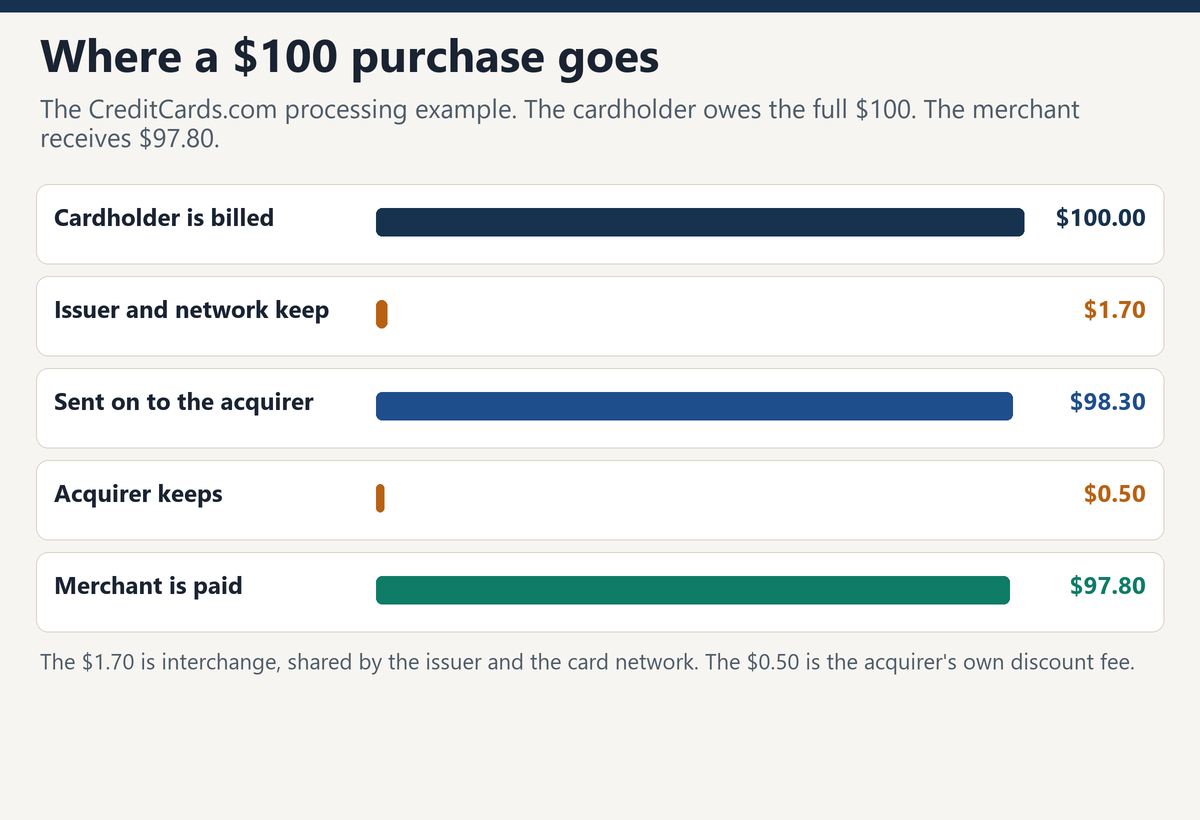
The deck’s fee slide is this same ticket, stated as rates. Interchange is 1.70 percent. The acquirer’s processing fee is 0.50 percent. Together they are a 2.20 percent merchant discount, so the shop keeps $97.80 of $100.
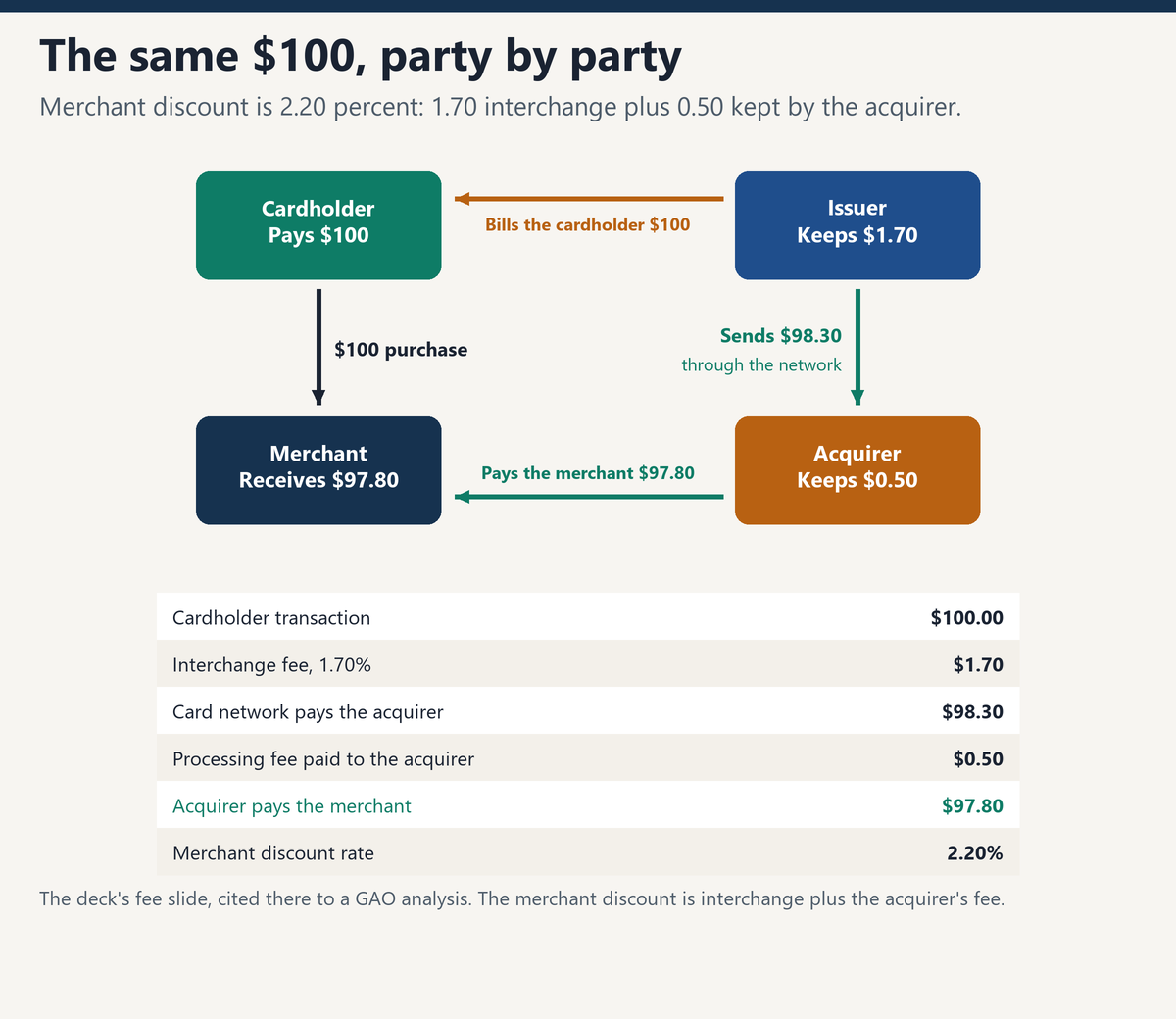
Read the merchant’s side and the cardholder’s side together. The shop gave up $2.20 to be paid quickly and to hand the credit risk to the issuer. You still owe $100. If you pay that $100 by the due date, the issuer’s income on this ticket is its share of the $1.70, plus any fee on the account. If you do not, the $100 becomes a loan.
The statement is a loan agreement in miniature
The deck’s term list is the vocabulary of that loan. Grouped, it answers four questions: how much you may borrow, how the interest is counted, which fees sit outside the interest, and how the bank watches the book.
| Question | Terms | What they mean on a statement |
|---|---|---|
| How much, and by when | Credit limit, purchases, previous balance, minimum payment, payment due date, grace period | The limit is the ceiling. Purchases are this cycle’s new charges. The previous balance is what you already owed. The minimum is the least the issuer will accept. The due date is when that payment has to arrive. The grace period is the interest-free window on new purchases when you pay in full. |
| What revolving costs | APR, variable interest, average daily balance, finance charge | The APR is the yearly price of borrowing. A variable APR moves with a reference rate. The finance charge is the interest in dollars, usually the average daily balance times the monthly rate. |
| Fees that are not interest | Annual fee, late fee, over-the-limit fee, cash-advance fee, balance transfer | An annual fee buys the card itself. A late fee is for missing the due date. An over-the-limit fee is for a charge the issuer allowed above the limit. A cash advance is cash now, usually with a fee and with interest from day one. A balance transfer moves debt from another card, often with its own fee. |
| How the portfolio looks | Transactors, revolvers, utilization, payment rate, days past due, GCL, NCL, ANR | Transactors pay in full. Revolvers carry a balance. Utilization is the balance divided by the limit. Payment rate is how much of the balance comes back as a payment. Days past due count lateness. Gross credit loss is what is written off. Net credit loss is that amount after recoveries. ANR, listed beside those on the deck, is the average net receivables in a card book: the balances the interest is earned on. |
One cycle, so the interest is visible
This arithmetic is an illustration, not a number from the deck. The method is the one the deck points at: interest on the average daily balance.
Take a 30-day cycle and a card whose APR is 24 percent, so the monthly rate is 24 ÷ 12 = 2 percent. The cycle opens at zero. On day 11 you buy $900 and you do not pay it during the cycle. The balance is $0 for 10 days and $900 for 20 days.
Average daily balance = (10 × $0 + 20 × $900) ÷ 30 = $600
Finance charge if the balance revolves = $600 × 0.02 = $12
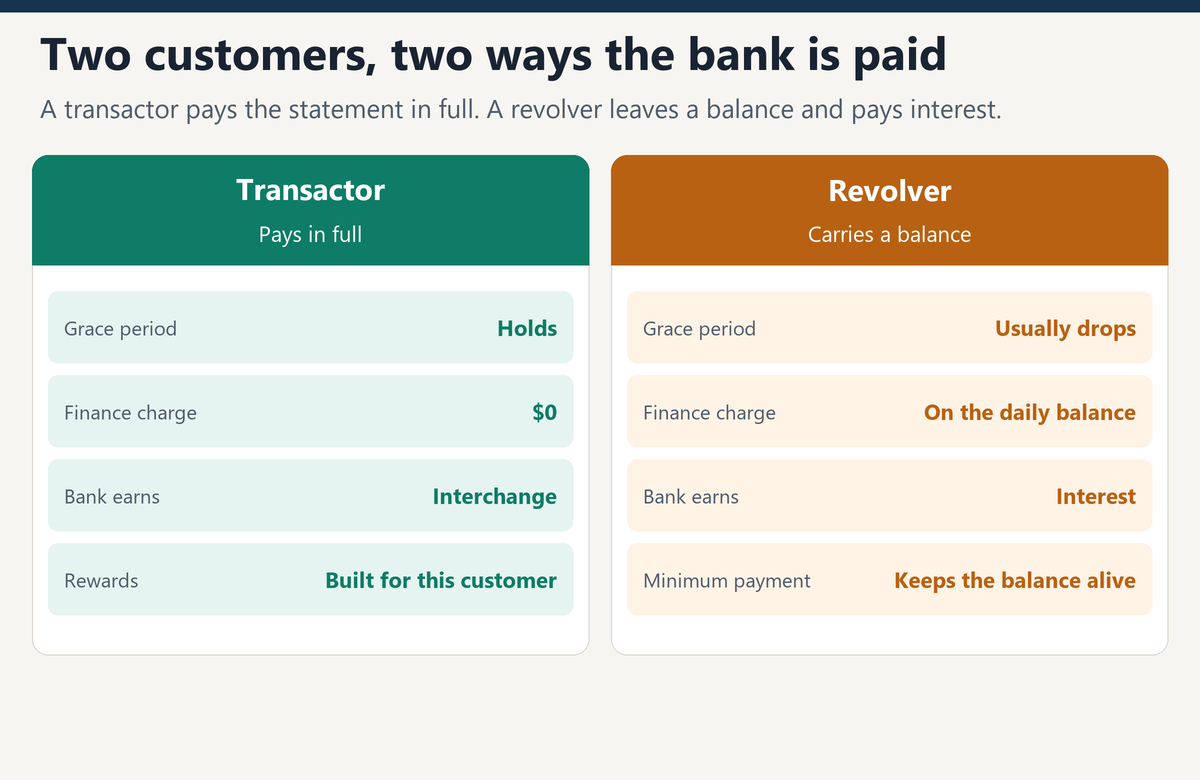
Pay the $900 in full by the due date, and a typical grace period means the finance charge on those purchases is $0. The issuer earned its interchange when the $900 was spent, and it earned no interest. Carry any part of the balance, and the grace period on a typical card drops away. New purchases start accruing as well. A cash advance usually never had a grace period. Paying only the minimum keeps the rest of the $900 revolving, and next month’s average daily balance is still most of the debt.
Why the issuer still wants both customers
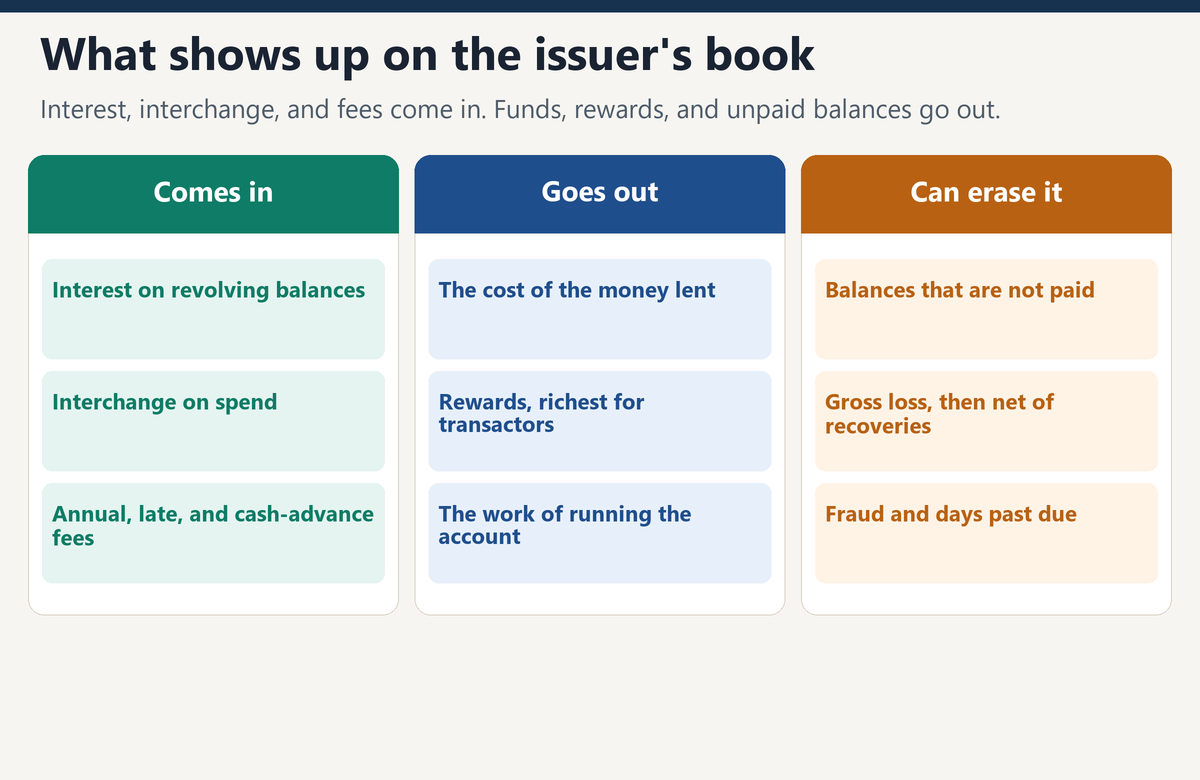
The deck’s profit-and-loss page, and the page of benefits aimed at transactors, are the two halves of the issuer’s bet.
Every swipe can earn interchange, whether or not you revolve. That is why a transactor is worth having. The issuer pays rewards, the richest of them aimed at people who pay in full, because the interchange and the annual fee have to justify the cost of those benefits. A revolver is a different engine. The $12 in the example above, repeated across a book of average net receivables, is interest income. Fees for late payment, cash advances, and the card itself sit on top.
Against that, the issuer is funding the receivables. The $100 it laid out has a cost of funds until you repay. Unpaid balances become days past due, then gross credit loss, then net credit loss once recoveries come back. Fraud is the same kind of hole. A high utilization, balance close to the limit, is an early signal that the line is stretched. It is not itself a loss.
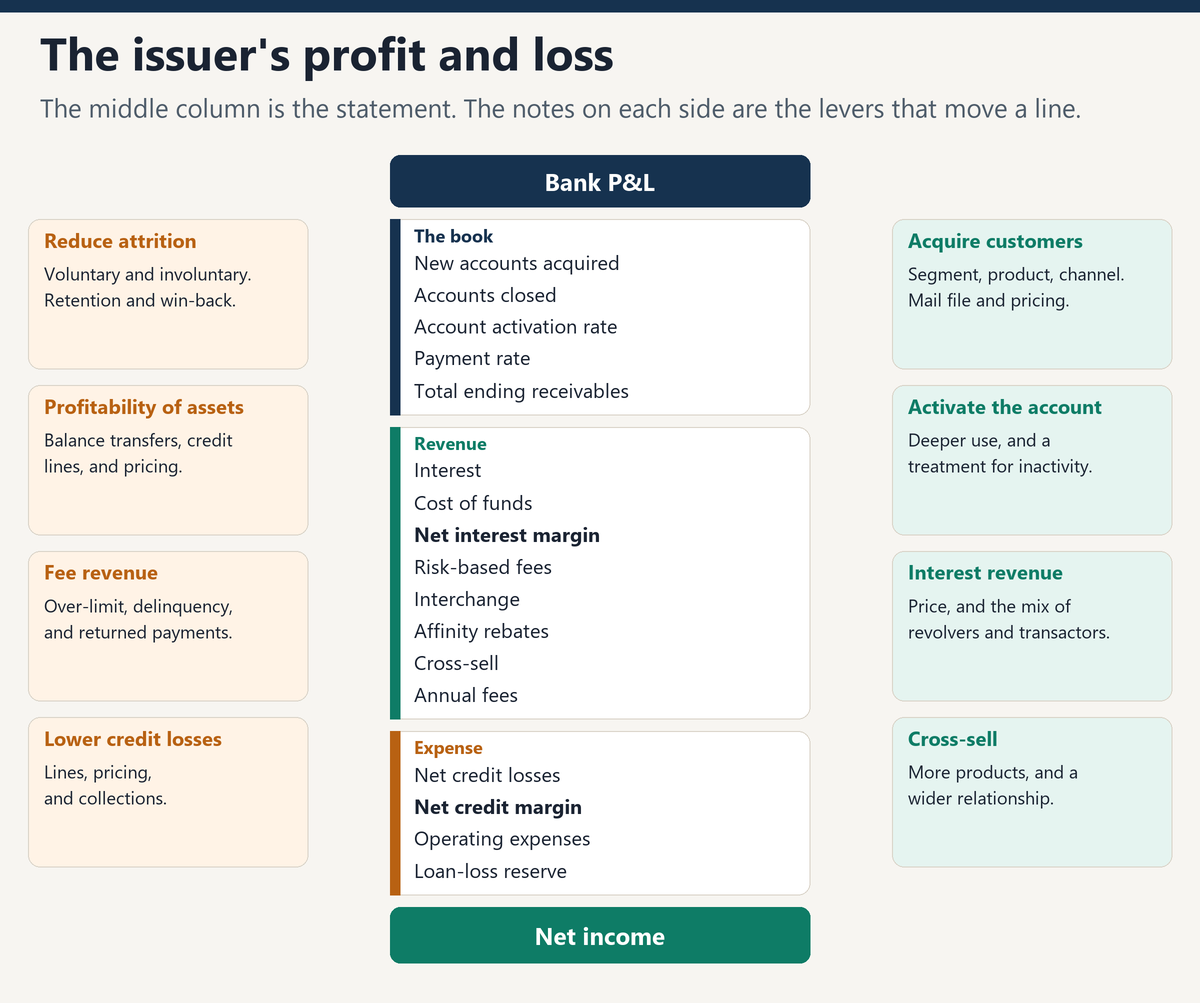
The deck’s profit-and-loss map, credited there to Marketelligent, is the full statement those three columns compress. The middle column is the statement. The notes on each side are the levers that move a line. Read the middle from the top: the book, then revenue, then expense, then net income.
The book is not income
The top block counts the portfolio. None of it is profit yet. New accounts acquired are the cards opened in the period. Accounts closed are the cards that left. The account activation rate is the share of opened cards that actually get used. An unactivated card is a name with no spend and no balance. The payment rate, already on the term list, is how much of the balance comes back as a payment. A high rate shrinks the loan. A low rate leaves it revolving. Total ending receivables are the balances still owed at the close of the period. That ending stock is not the same number as ANR. ANR is the average of the receivables through the period, and the interest is earned on the average.
What sits under the margin
Interest minus the cost of funds is the net interest margin. On this map the cost of funds sits in the revenue block, directly under interest, because the margin is that subtraction. It is not waiting down in expense with the credit losses. The margin is a subtotal, not the bottom of the page.
Still in revenue, after the margin, the map lists five income lines. Risk-based fees follow how the account is used: a charge over the limit, a delinquency, or a payment that is returned unpaid. They are not the annual fee, which is the price of holding the card and is its own line. Interchange is the issuer’s share of the merchant discount, earned on spend whether or not the balance revolves. Affinity rebates are income from a partner whose name is on the card, a store or an airline or a club. Cross-sell is income from other products the same customer takes. The map’s own note is that affinity rebates and cross-sell are income lines.
Expense is taken in order. Net credit losses come off first: balances written off, after recoveries. What remains is the net credit margin. Operating expenses, the work of running the accounts, come off after that margin. So does the loan-loss reserve, the amount set aside for losses that have not been written off yet. The reserve is a separate line from the loss. One is debt already gone. The other is the provision for debt that may go. Net income is what is left.
The eight levers
Each note names an action and the line it is meant to move. The four on the left work on the book the bank already has. The four on the right bring accounts in and give them something to earn.
| Lever | What the map says | The line it moves |
|---|---|---|
| Reduce attrition | Voluntary and involuntary. Retention and win-back. | Accounts closed. Voluntary is the customer leaving. Involuntary is the bank closing the account. Retention keeps someone. Win-back asks someone who left to come back. |
| Acquire customers | Segment, product, channel. Mail file and pricing. | New accounts acquired. The segment is who is offered a card, the product is which card, and the channel is how the offer goes out. The mail file is the list of people who receive it. Pricing is the rate and the fee on that offer. |
| Activate the account | Deeper use, and a treatment for inactivity. | The activation rate. Deeper use is more spend on a card already open. A treatment for inactivity is aimed at an account that has gone quiet, so the line does not sit unused. |
| Profitability of assets | Balance transfers, credit lines, and pricing. | Ending receivables, and what those balances earn. A balance transfer brings another lender’s debt onto this book. The credit line sets how large the balance can grow. Pricing is the rate charged on it. |
| Interest revenue | Price, and the mix of revolvers and transactors. | Interest, and so the net interest margin. Price is the APR. The mix is how much of the book revolves. A transactor pays in full and adds no interest. The same mix moves the payment rate: transactors pay the balance down, revolvers do not. |
| Fee revenue | Over-limit, delinquency, and returned payments. | Risk-based fees. Over-limit is a charge the issuer allowed above the line. Delinquency is the late fee already on the term list. A returned payment is one that comes back unpaid. |
| Lower credit losses | Lines, pricing, and collections. | Net credit losses, and so the net credit margin. A smaller line caps how much can be written off. Pricing is higher where the risk is higher. Collections is the work that brings a late balance back, which is what turns a gross loss into a net one. |
| Cross-sell | More products, and a wider relationship. | The cross-sell income line. The same customer takes a second product, and that income is counted on the card book. |
Put the $100 sale back on that book. The merchant received $97.80. The network and the issuer split $1.70. The acquirer kept $0.50. If you are a transactor, the story ends with that interchange, minus rewards and the cost of a few weeks of float. The payment rate on that ticket is the whole balance, and ending receivables do not keep the $100. If you are a revolver, the $100 stays in ending receivables and the APR goes to work on the average daily balance. A late fee, an over-limit fee, or a returned payment would show up as a risk-based fee, not as interest. The issuer’s good year is a lot of spend, a book that activates and does not attrite, a controlled mix of revolvers, and losses that do not eat the net credit margin. A bad year is rewards that cost more than interchange, or credit losses that erase both the margin and the fees.
What to look at on your own card
- Name the parties on a purchase: you, the shop, the shop’s bank, the network, and the bank that issued the card. The receipt is not the moment the money moves.
- Treat interchange as the merchant’s cost of the swipe, not as a fee printed on your statement. On the sample ticket it was $1.70 of $100, shared by the issuer and the network, with another $0.50 for the acquirer.
- Pay the statement in full by the due date if you want the grace period. The interest then due on ordinary purchases is zero.
- If you carry a balance, compute the average daily balance before you look at the APR. A 24 percent APR on a $600 average balance for a month is $12, not 24 percent of $600.
- Read rewards as a cost the issuer pays to win transactors. Read a minimum payment as a decision to stay a revolver.
- On the issuer’s statement, read the book before the income. Accounts acquired, accounts closed, activation, the payment rate, and ending receivables say whether the income lines have anything to earn on. Interest minus the cost of funds is only the net interest margin. Risk-based fees, interchange, affinity rebates, cross-sell, and the annual fee sit under it. Losses come off before the net credit margin.

